
Posted on April 23, 2019
René Kolman is Secretary General at the International Association of Dredging Companies (IADC), the global umbrella organisation for contractors in the private dredging industry. With over one hundred main and associated members, IADC is dedicated to not only promoting the skills, integrity and reliability of its associates, but also the dredging industry in general. Kolman takes a leading role in promoting the industry’s long-standing commitment to environment and sustainability. He studied at the Nautical School in Rotterdam and holds a degree in Economics from the University of Groningen in the Netherlands.

What are your main responsibilities as Secretary General at IADC?
I am in charge of developing and managing the dissemination of information about dredging and its positive role in society. Through seminars, publications and presentations at conferences, IADC offers support to port authorities, developers and stakeholders on a diversity of subjects such as technology, environment and climate change. I represent the international dredging industry through collaborations with the International Association of Port and Harbours (IAPH), The World Association for Waterborne Transport Infrastructure (PIANC) and the World Dredging Association (WODA). I am a member of several IAPH and PIANC committees as well as PIANC’s Permanent Task Group Climate Change. I am also responsible for all activities organised within the association such as educational activities for employees of member companies, multiple working groups at sister associations and the Annual General Meeting.
What are the main functions of IADC and how do members benefit from the Association?
IADC has five core functions: informing, promoting, educating, networking and connecting. The publication of the “Terra et Aqua” journal is the most prominent activity with regard to informing. It is the only near scientific journal on the subject of dredging. In addition to this, there is a very extensive knowledge base on our website. If you can’t find the answer to your question, just send an email or give us a call and we will get the answer for you from experts in our network of members.
Promotion is done through articles in different magazines as well as by giving presentations at conferences. There is lot of outdated ideas still circulating about the dredging industry and its methods, and our goal is to update these outdated perceptions. The book “Dredging for Sustainable Infrastructure” (DfSI), published with CEDA, demonstrates that the dredging industry is the frontrunner thanks to its sustainable attitude. IADC organises seminars on dredging to inform its participants about what dredging is really about. For example, what environmental footprint does a dredging project have? And what types of equipment can be used? Based on the DfSI book, we are developing a new course which explains the new design philosophy. Instead of focusing on compensation and mitigation of negative impacts we try to maximise the value of a marine infrastructure work in a sustainable way. We are convinced this will be the way forward in all kinds of dredging projects.
We have a lot of interaction with related industries. We are a small sector but with a large economic and social impact. Our activities will have much more impact when we team up with other organisations. For this, we participate in working groups by PIANC and IAPH. Recently, we organised a workshop at the Global Session of the UN Science-Policy-Business Forum on the Environment in the lead up to the Fourth Session of the UN Environment Assembly together with PIANC and CEDA.
IADC has 11 members which are all privately-owned companies who work all around the globe. Their employees meet in working groups to work on the “Dredging in Figures” publication, the cost standards for dredging equipment, the development of safety standards or during educational activities.

What are the main points to look out for before initiating a dredging project?
The recently published DfSI book introduces a new design philosophy. When initiating a dredging project, you have to look at all three pillars of sustainability. It is important to consider nature-based solutions for your infrastructure demand. It is not only more sustainable but projects with nature-based solutions are easier to finance. How do the impacts of the project interact? And how can the overall value be maximised? It is necessary to identify all stakeholders upfront and have them at the table from the very early beginning of the project. It will cost an extra effort at the start but you will benefit from it in all stages of the project. Execution will be smoother as risks have been identified and discussed properly, and the support of the public will increase.
What is adaptive management in a dredging project and what are the benefits?
Dredging and placement projects are often permitted with license conditions based on an extensive Environmental Impact Assessment (EIA). This may result in strict thresholds to assure environmental performance with levels deemed to be acceptable, based on the findings of impact assessments.
In other cases, less clear environmental limits are specified. This is sometimes due to the level of uncertainty about effect on and responses by nature caused by inability to fully appreciate and judge environmental conditions (sensitivity of receptors) and potential project effects (vulnerability to changes), or for other reasons such as sharing responsibilities and risks. Effects on the environment can be both negative as well as positive and monitoring of both outcomes is sometimes required, although monitoring of potential negative impacts is more common to ensure protection of the environment.
For those dredging projects where the outcome is less certain, or accompanied by a low confidence in the prediction of effects, a sequence of more intense and targeted monitoring, impact assessment and management actions might be implemented. Where this is the case, there may be benefits in adopting an adaptive management strategy whereby the management of the project can be adapted based on the ongoing findings of the monitoring programme. This approach can benefit the sensitive receptor as management can be adjusted to ensure full protection. The project owner can also benefit as overly conservative mitigation measures can be downsized during the course of the ongoing monitoring. This sequence of activities is jointly understood as ‘adaptive management’, although interpretation and ways of implementation may vary considerably between projects, and even between different stakeholders on any project. Adaptive management helps to achieve desired goals by addressing uncertainty, incorporating flexibility and robustness into project design, and using new information to inform decision-making as the project develops. Goals include an efficient project design and streamlining implementation protocols to minimise waste of resources which, when holistically viewed, could decrease the project’s overall environmental footprint. For more information about the subject in the DfSI book. https://www.sustainabledredging-book.com/about-the-book.html
What are the most common dredging techniques?
The characteristics of the dredging process change considerably from one project to another.
However, a number of different phases that are common to almost any dredging process regardless of the type of equipment used for its execution, can be identified. These phases are:
- dislodging of the in-situ material;
- raising of the dredged material to the surface;
- horizontal transport; and
- placement or further treatment.

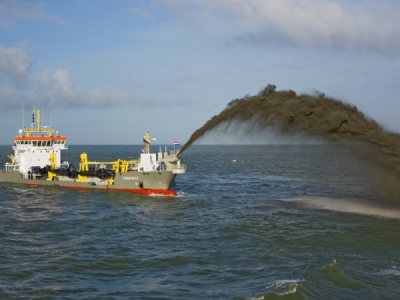
The first phase of a dredging cycle is dislodging of the in-situ material. This dislodging process is essential as removing the whole volume en-masse is impossible. The excavation process can be relatively simple in the case of soft sediments but sometimes, where the removal of hard rock is concerned, it can be difficult. Dislodging is generally carried out by a cutting device such as cutterhead, draghead or the cutting edge of a bucket. Sometimes water jets are used for this purpose.

During the second phase of a dredging cycle, the dislodged material is raised. This can be done either mechanically or hydraulically. Using the mechanical alternative, the material is raised in a grab or bucket (e.g. backhoe or bucket ladder dredgers). In the second case, hydraulic dredgers (e.g. suction, cutter suction, trailing suction hopper dredgers) use a suction pipe. The dislodged material is then sucked into the suction mouth by means of a centrifugal pump. The material is further raised through the suction pipe towards the pump and, from there, through the discharge line to the deck of the dredger.
The third phase of the dredging cycle is the horizontal transport of the excavated and raised material from the dredging area to the site for further treatment or final relocation. This can be achieved mainly by one of three methods:
- hydraulic pipeline transport;
- transport by hopper dredgers; or
- transport by barges.
The final phase of a dredging sequence is the relocation of the excavated material to its final destination or to an intermediate site for further treatment.
There is a current overcapacity in the dredging market. Do you foresee this to continue in the medium / long term?
The IADC’s members have invested a lot in modern equipment dedicated to their specific tasks in the last 10 years. IADC members are very engaged in reducing their environmental footprint. The first dual fuel hopper dredgers are already on the job. On the other hand, the “Dredging in Figures” shows a decrease in the market over the last couple of years. China and the United States are closed markets for dredging companies from outside these countries, so a large ‘piece of the pie’ is not accessible. The drivers of the industry are world trade, coastal protection, energy, tourism and urban development. Over the long-term, the signs for these drivers all show green.
What markets have more potential over the coming years?
History shows that the focal point of the industry’s activities shift all over the world. In the early 2000s, the Middle East was the centre of activities while ten years later, it was Australia with port development projects to export resources like iron ore and LNG. Looking to the drivers, one might expect more coastal protection projects due to sea level rise and subsiding land in low-lying deltas. An increasing number of people are living in urban areas near the coast. To accommodate all these people, urban development projects are necessary. The UN predicts an increase of the population in Africa, resulting in an increase of imports and exports through ports. An increase in the size of vessels makes deeper ports necessary. This will result in work for dredging companies.
How is the dredging industry renewing the technical skill sets of their crew and develop new people?
The dredging industry spends a lot of time and effort to keep their crew and staff well-trained. As for job training, the crew is trained on simulators for different types of equipment like a hopper, cutter or backhoe. This is not only done at the headquarters but also with mobile simulators on large projects. Several members of IADC have started to use Virtual Reality for training purposes. There is hardly any other production industry that has approximately 50% of its staff educated at a Bachelors or higher degree level. It is not uncommon to have PhD-level colleagues within the dredging industry. Developments in digitisation happen quickly, and with state of the art equipment, crew and staff have to be trained continuously to keep companies in a leading position in the market.

Better-trained crew reduces risks which leads to better results and less accidents. Training is not only done for professional competences but also for safety. The overall culture in the industry focuses more and more on safety. Personnel is the most valuable asset of dredging companies and they can make all the difference among competitors. The importance of safety has long been recognised by all IADC members and has resulted in a large reduction of ‘lost time injuries’.
Please talk about the safety and environmental regulation standards applied to the industry and if there are any challenges:
The current safety culture was sparked by the oil and gas industry some 20 years ago. The dredging companies were only allowed to do work for the oil and gas industry when they complied with the sector’s safety standards. Today, safety is paramount in the entire dredging industry. Safety culture and standards of the larger dredging companies are sometimes ahead of those in the offshore industry. IADC recently started a working group to set minimum standards for maintenance yards. Members in the association share experiences to learn from each other with the single aim of making the working environment safer and reducing the number of incidents. Every year, IADC grants a Safety Award to an organisation increasing safety in the dredging industry. Conceived by dredging companies or suppliers, nominations include projects, vessels, safeguards or innovations in other working environments. IADC believes there are many exemplary innovations to make the process safer and its award recognises their benefits to the industry as a whole. The deadline to submit nominations to compete for this year’s Safety Award is 1 July 2019.
IADC recently published the book “Dredging for Sustainable Infrastructure” in collaboration with CEDA. In the past, the dredging industry’s focus was on mitigating and compensating for a project’s negative effects. In this book, a new design philosophy is presented which focuses on creating as much added value as possible. A marine infrastructure project has to create value in all three pillars of sustainability: economic (which is very often the main purpose of the project), social and environmental.
Contractors were at the cradle of nature-based solutions which perfectly fit into this new philosophy. Nature can support in realising new infrastructure for a win-win situation. Major environmental issues include emissions, sound and turbidity. To assess the influence of the work process on these three elements, it is necessary to understand the natural system in which is operated. A zero-base impact assessment is evident and the use of adaptive management makes the environmental monitoring efficient and relevant. It provides essential data to adjust the work process to meet environmental regulations.
Technology plays an important part in dredging. Please tell us about any recent innovative ideas that members of IADC have applied to the industry:
Most of the innovations are developed in projects. The contractor has to adjust his or her way of working on a project to meet environmental regulations. Involved parties have to discover how processes and equipment can be adapted to meet the requirements which are already set. This will result in incremental innovations. You don’t see real game changers in the industry. Dredging means loosen the material, lift it out of the water, transport it and deposit the material. This has already been done for centuries in a mechanical way and since the last century, in a hydraulic way. The size of hoppers has increased over the past decades. Today, we have two cutters which are being built with more than a 50% increase in capacity compared with the present largest. But there is no real difference apart from the size.
A lot of scientific research has been conducted and this has resulted in a better understanding of the process and a lot of small changes in equipment. The impact of the dredging process on the environment is better understood and we know how to reduce the impact. The newly designed overflow and green valve have resulted in less turbidity and air entrainment. Crew can sleep on board of cutters because the accommodations are protected from vibrations with an air isolation. These may seem small but they are very important improvements to both the equipment and process. On the other hand, innovative ideas share a common fate: innovations are typically kept secret until they eventually become common knowledge. So maybe we can expect a real game changer in the near future.
Source: linkedin.com


